Independent agent field guide
How to Compare Insurance Agency Support Models Before Switching Uplines
To compare insurance agency support models, look past commission splits and evaluate six concrete things: how commissions are tracked and reconciled, what training and platforms are actually included, how client acquisition and referrals are supported, how case escalations get handled, what happens if you want to leave, and whether the people you'd work with are accessible day to day. Ask each upline candidate to show you the actual tools and workflows, not just describe them, and get any release or ownership terms in writing before you sign.
By Muehl Group ·
Why does the upline you choose matter so much?
An upline or field marketing organization doesn't just process your contracting paperwork. It shapes how quickly you get paid correctly, how much you have to learn on your own, and how much help you get when a case gets stuck. Two agencies can offer the same carrier contracts and still deliver completely different day-to-day experiences.
What changes when you switch uplines
Your carrier appointments, your support contacts, your access to back-office tools, your training resources, and often your commission processing all change when you switch. Some of these transitions are seamless. Others create gaps in service right when clients need you most, especially during enrollment periods.
What stays the same because you're independent
You keep your book of business relationships, your own brand and client trust, and your ability to operate the way you choose. A support model should add infrastructure around that independence, not replace it. Any agency that frames the relationship as employment rather than partnership is worth questioning.
What should you actually compare before switching?
Most agents compare commission percentages first because it's the easiest number to see. That's a mistake if it's the only thing you compare. Here are the categories that actually determine whether a support model helps you long term.
Commission tracking and statement reconciliation
Ask how commissions are tracked and whether there's a system that reconciles carrier statements against what you're owed. Manual reconciliation, or none at all, means errors go unnoticed and disputes take longer to resolve.
Training and onboarding depth
Ask whether training is a one-time onboarding event or an ongoing, on-demand library you can return to as products, carriers, and rules change. Health and Medicare rules shift often enough that static training goes stale fast.
Client acquisition and referral support
Ask what specific, repeatable workflows exist to help you build referral relationships and stay in front of past clients, not just a general promise of "marketing support." A vague answer here usually means there isn't a real system behind it.
Case support when things get complicated
Ask who you call when a case is stuck—an underwriting question, a coverage gap, a plan change—and how fast they typically respond. This is where agents feel the difference between a support model and a name on a contract.
Technology and platform access
Ask which CRM, quoting, and enrollment platforms you'll have access to, whether onboarding help is included, and whether the tools are ones carriers and regulators recognize as compliant for client-facing work.
Release and contract terms
Ask what the release policy is if the relationship doesn't work out, and get it in writing. A support model confident in its own value should have no problem being clear about how you can leave.
How do you evaluate commission tracking specifically?
Commission errors are common industry-wide simply because there are so many moving parts: carrier statement formats vary, effective dates shift, and chargebacks happen. The real question isn't whether errors ever occur—it's whether there's a system built to catch them. Ask a prospective upline to walk you through their actual reconciliation process, not just describe it in general terms. Muehl Group's commission tracking and statement reconciliation tool is one example of what a working system looks like: agents can see tracked commissions against carrier statements rather than relying on memory or spreadsheets.
What does real training and support look like day to day?
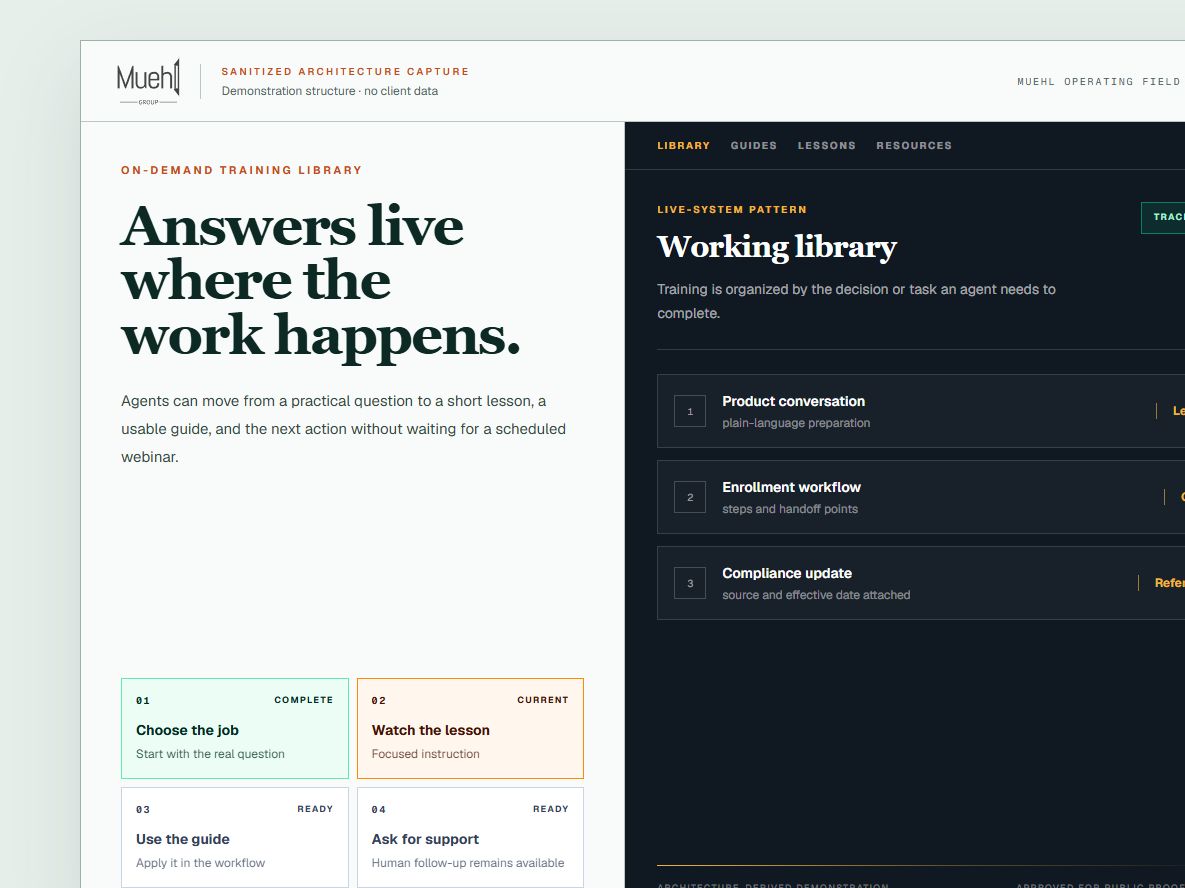
Training that matters to a working agent is available when you need it, not just during a scheduled onboarding week. Ask whether there's an on-demand library covering product changes, compliance updates, and practical selling scenarios. Also ask how contracting and case questions get handled once you're established—responsive support from people who know your book tends to matter more over time than a polished sales pitch during recruitment. Muehl Group's on-demand training library and its contracting and case support process are built around that ongoing need rather than a single onboarding event.
How should you weigh marketing and referral support?
Client acquisition is one of the hardest parts of independent agency work, and it's where vague promises are most common. Instead of accepting general claims, ask for specifics: Is there an included tool, like a social media marketing tool, versus paid services like managed SEO or paid advertising? Is there a referral marketing engine with actual repeatable workflows, or just encouragement to "ask for referrals"? Muehl Group separates these clearly: a social media marketing tool is included for downline agents, while managed SEO and paid-ad support are available as separate paid services, and the referral marketing engine provides structured workflows rather than generic advice. Understanding which pieces are included versus paid helps you compare offers accurately instead of assuming more than what's actually promised.
What questions should you ask before you sign anything?
- Can you show me the commission tracking tool, not just describe it?
- What does the training library actually contain, and can I preview it?
- Who handles a complicated case, and how quickly do they typically respond?
- Which platforms will I have access to for CRM, quoting, and enrollment?
- What is the release policy if I want to leave, in writing?
- Which services are included versus billed separately?
A support model worth joining will answer these directly. Hesitation or vagueness on any of them is useful information.
How does Muehl Group approach these same questions?
Muehl Group was built around the idea that independent agents shouldn't have to choose between staying independent and having real infrastructure behind them. That means giving agents visibility into their own commissions through a built commission tracking and reconciliation tool, ongoing access to a training library, a coverage recovery workflow for eligible Medicaid transitions, and support onboarding onto IntegrityCONNECT and MedicareCENTER, Integrity's agent platforms for CRM, quoting, enrollment, and compliant client service. Agents also get access to a referral marketing engine and, separately, paid managed SEO and advertising services if they want additional growth support beyond what's included. None of this guarantees a particular income or growth outcome—no agency can honestly promise that—but it's built to give agents clearer records, more repeatable habits, and dependable people to call when a case gets hard. The full agent support and operating-stack overview lays out what's included and what's available as a paid add-on, so you can compare it apples to apples with any other model you're considering.
Frequently asked questions

Questions readers often ask
What's the biggest mistake agents make when comparing uplines?
Comparing commission percentages first and treating everything else as secondary. Support quality, training depth, and how commission tracking actually works day to day usually matter more over the life of your book than a percentage point difference.
Should I ask to see tools before switching, not just descriptions?
Yes. Any upline offering commission tracking, training, or marketing tools should be willing to show you the actual product, not just describe it in a pitch. If they can't show it, treat that as meaningful information.
Is a higher commission split always the better deal?
Not necessarily. A higher split with weak back-office support, no reconciliation system, and no responsive case help can cost you more time and errors than a slightly lower split with dependable infrastructure behind it.
What should a release policy include?
It should clearly state, in writing, the conditions under which you can leave and what happens to your book and contracts. Ask for this in writing before signing anything, and don't rely on verbal assurances.
Are managed SEO and paid advertising usually included in upline support?
Not typically, and agents should ask directly. At Muehl Group, for example, a social media marketing tool is included for downline agents, while managed SEO services and paid advertising support are offered as separate paid services.
How do I know if case support will actually be responsive?
Ask who specifically handles complicated cases and how quickly they typically respond, and ask if you can speak with current agents about their experience. Vague answers about a general "support team" without named contacts are a warning sign.